Is My Child Ready for Sleepaway Camp?
If you’re asking yourself, “Is my child ready for sleepaway camp?” you’re already doing the most important part of the process, thinking it through instead of just signing up and hoping for the best. Overnight camp readiness isn’t really about hitting a certain age. Some kids are ready at seven, others need another year or two, and both are completely normal. What actually matters is a mix of independence, comfort with being away from home, and genuine interest in the experience itself.
At Camp Pillsbury in Owatonna, Minnesota, we work with campers ages 6 to 17 every summer, and readiness looks different at every stage of that range. This checklist is meant to help you think through where your child stands right now, not to talk you into or out of anything.
Signs Your Child May Be Ready
Every child develops at a different pace, but a few common signs tend to show up when a kid is ready for overnight camp.
- They’ve had a successful sleepover: If your child has spent a night at a friend’s or relative’s house without major distress, that’s one of the clearest indicators. Sleeping somewhere unfamiliar, without a parent in the next room, is a big part of what camp asks of a child, so prior practice matters.
- They can manage basic self-care: Brushing teeth, showering, getting dressed, and keeping track of their own belongings without constant reminders are all skills that matter at camp, where counselors are managing a group rather than one child at a time.
- They’ve expressed interest on their own: a child who’s curious about camp, asking what it’s like or bringing it up unprompted, tends to adjust faster than one who’s only going because a parent suggested it. That doesn’t mean hesitant kids can’t thrive, but genuine interest is a good sign.
- They’ve adapted to new environments before: a new school year, a new teacher, a new sports team – any experience where your child had to adjust to unfamiliar people and routines is a preview of what the first few days of camp will feel like.
- They can handle small frustrations without a parent nearby: Camp involves problem-solving without mom or dad immediately available, whether that’s a disagreement with a bunkmate or trouble following a new schedule. Kids who can work through small frustrations on their own tend to settle in more easily.
First-Time Camper Tips for Parents
If your child is showing several of these signs, a little preparation ahead of time can make the transition smoother.
- Talk about what camp will actually be like: walk through a typical day, what meals look like, when activities happen, and who they’ll be spending time with. The less mysterious the camp feels going in, the easier the adjustment tends to be.
- Practice separations before the big one: A few more sleepovers or a short overnight trip in the weeks leading up to camp can help build confidence, especially if your child hasn’t slept away from home very often.
- Involve them in packing: Letting your child help decide what to bring, including a comfort item like a stuffed animal or book, gives them some ownership over the experience instead of it feeling like something being done to them.
- Set expectations around communication: Know ahead of time how and when you’ll hear from your camper, so neither of you is caught off guard by a quiet stretch of days.
What This Looks Like at Camp Pillsbury
At Camp Pillsbury, campers sleep in dorm rooms with two to three campers total, and families can request a specific roommate ahead of time. If no request is made, campers are placed in an age-appropriate room. Curfew starts with the youngest campers at 9:30 p.m. and extends to 11:00 p.m. for older ones, and mornings start with an 8:30 a.m. wake-up on weekdays.
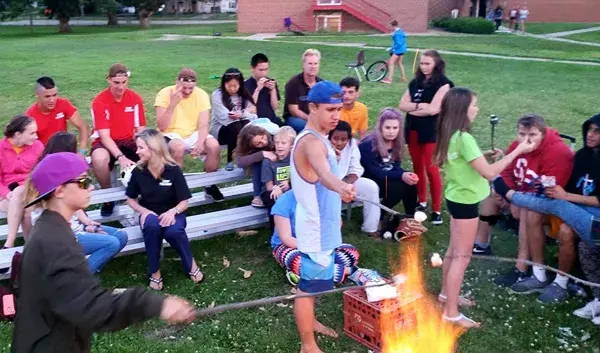
Majors are chosen at the start of each session and are taken at the same time each day with the same staff and campers, giving first-time campers a chance to settle into a consistent routine early on. Curious what a typical activity, like our circus program, actually looks like? Campers also get to pick three minors each day, giving them room to try something new without committing to it long-term, which can ease some of the anxiety around “picking wrong.
We also have First Aid-certified staff on-site, with a doctor on call and the Mayo Clinic nearby, so parents don’t have to wonder what happens if their camper gets a scrape or feels under the weather. Cell phones are allowed in the dorms but not during activities or meals, which keeps kids present in the moment without cutting off contact entirely.
If you still have questions about daily routines, packing, or what to expect during your camper’s first session, our FAQs page covers the details parents ask about most.
Trust the Process
There’s no perfect formula for knowing when a child is ready for overnight camp, and plenty of kids who seemed unsure going in end up having the best summer of their year. Readiness isn’t a fixed checkbox – it’s more of a spectrum, and many of the skills on this list, from handling frustration to feeling comfortable away from home, actually get stronger because of the camp experience itself, not just before it. If your child shows even a few of the signs above, and you’re willing to walk through the preparation together, that’s often enough to get started.
It also helps to remember that separation anxiety, both a child’s and a parent’s, is a normal part of this process. Most kids adjust within the first few days once they settle into a routine and start building friendships with their bunkmates. Knowing that ahead of time can make those first homesick moments feel less alarming if they happen.
Ready to see if Camp Pillsbury is the right fit for your camper? Enroll now to reserve a spot for the upcoming summer session.